Range and safety at the same time, Micro Power New Energy 13350-500mAh battery cell review
- 时间:2024-05-05
- 类型:Company News
Preface
Globally, with the continuous progress of science and technology and the increasing awareness of environmental protection, the development of new energy technology has become an important force to promote the sustainable development of the future society. As an indispensable component of new energy technology, the performance of batteries is directly related to the progress and innovation in many fields such as mobile electronic devices and wearable devices. Especially in today's increasingly popular portable electronic devices, the performance of the battery not only affects the endurance of the product, but also relates to the user's experience and safety.
Previously, the battery trading network introduced in detail the appearance and specifications of the new energy 13350-500mAh battery cell, the following from the charging and discharging performance, internal resistance and temperature of the three major aspects of a comprehensive analysis of the performance of this battery cell.
Appearance
As usual, let's take a look at the appearance and specifications of this battery cell.
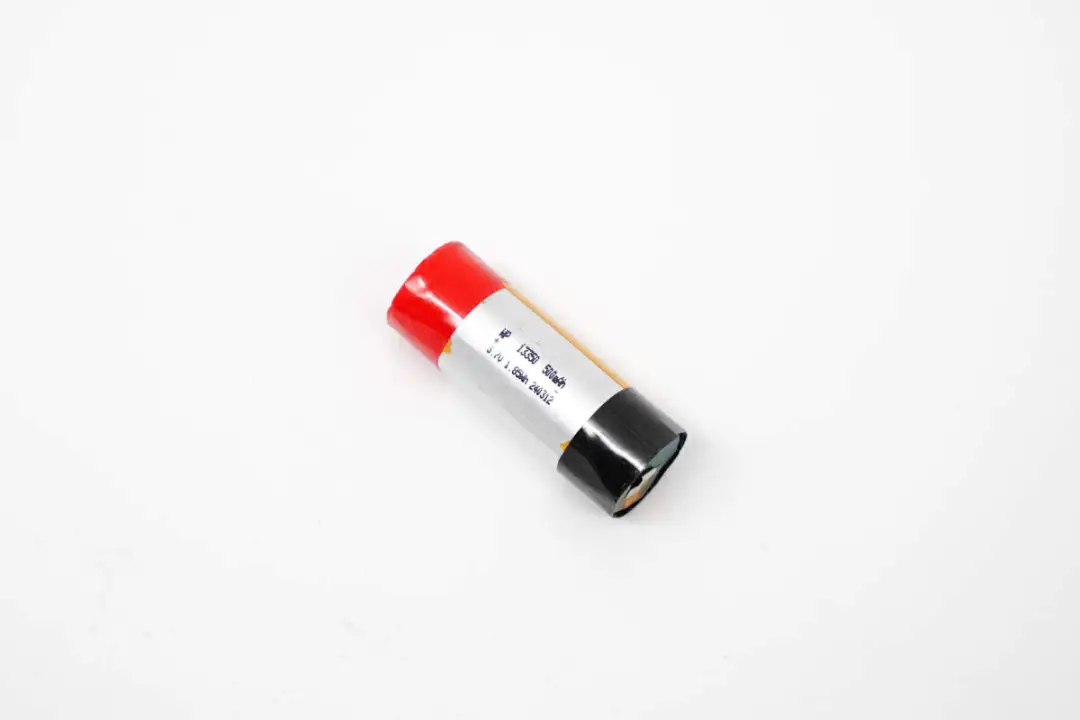
The overall Micro Power New Energy 13350-500mAh battery cell is a cylindrical structure with conventional aluminium-plastic composite film encapsulation, with positive and negative lugs leading from both sides.
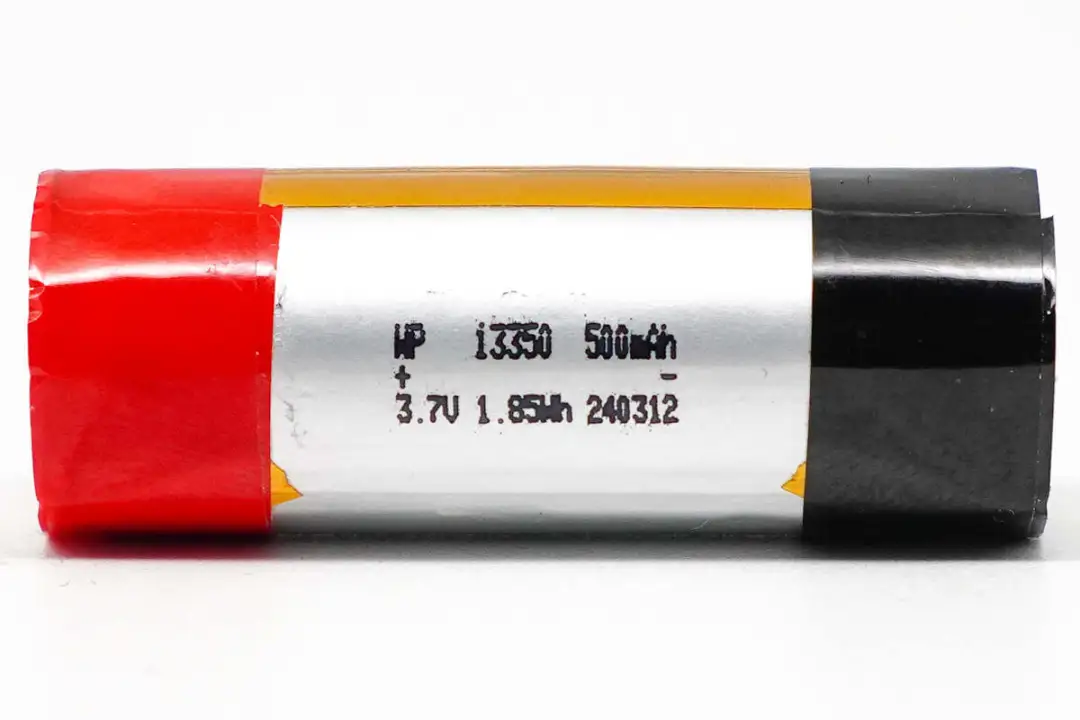
Micro Power New Energy 13350-500mAh battery cell front printed with the relevant parameters of the word:
"WP 13350 500mAh" and “+” and “-” positive and negative markings.
Typical capacity: 500mAh@0.2C.
Nominal voltage: 3.7V; Nominal energy: 1.85Wh.
AC internal resistance: ≤80mΩ.
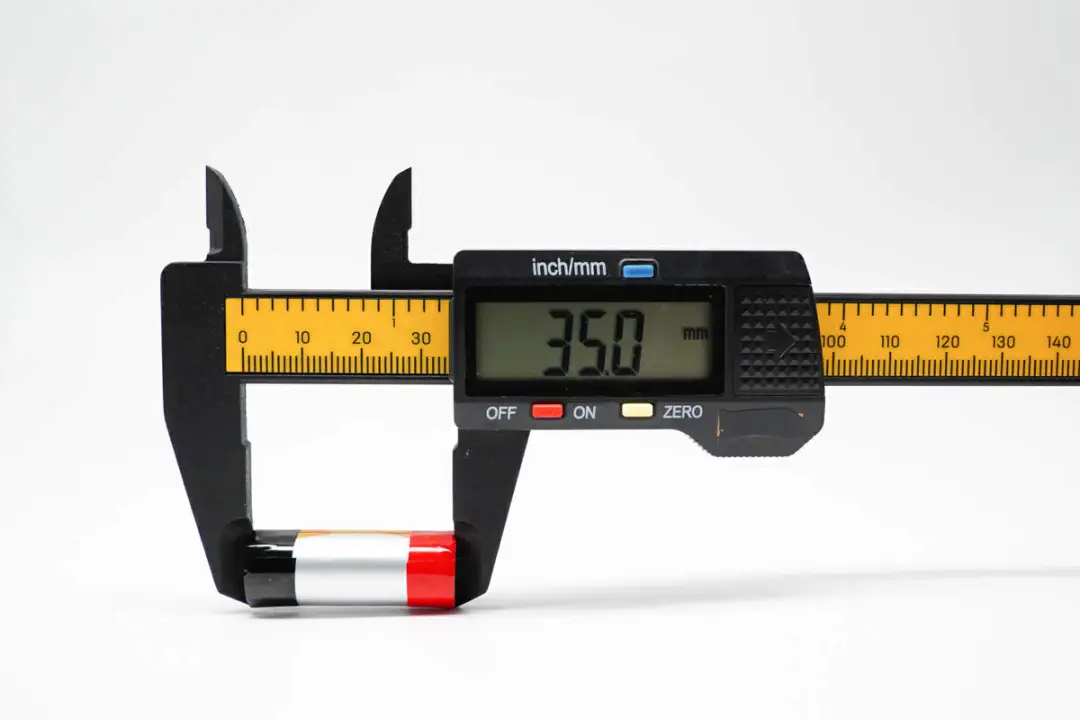
The height of the Micro Power New Energy 13350-500mAh cell is about 35mm.
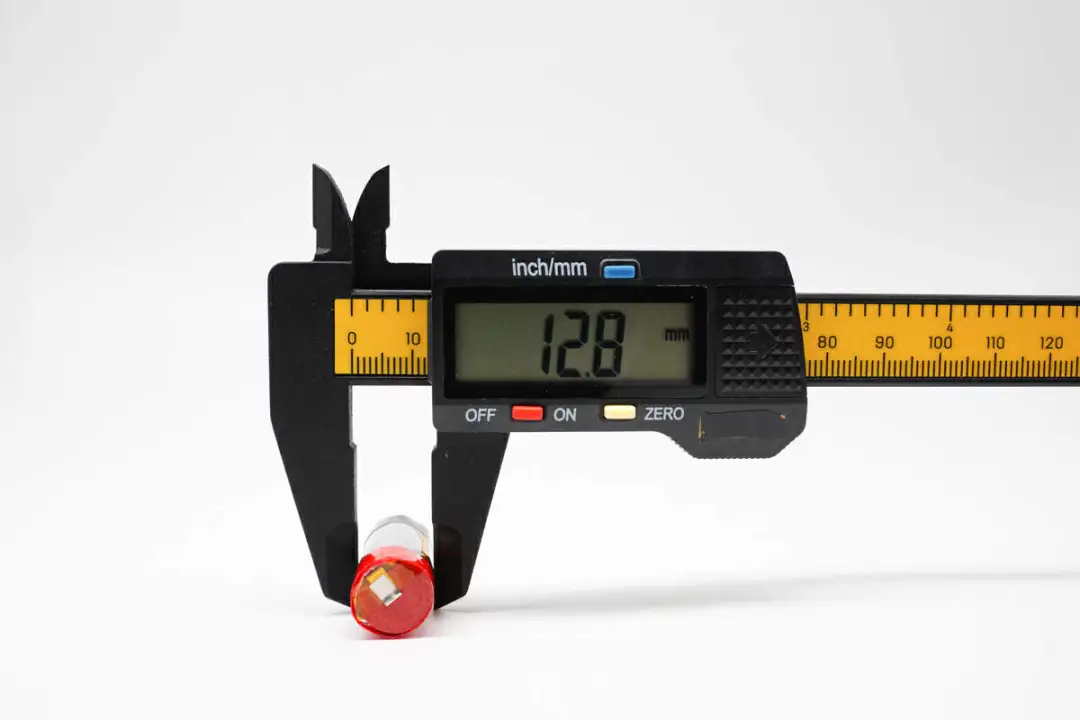
The diameter of the Micro Power New Energy 13350-500mAh cell is about 12.8mm.
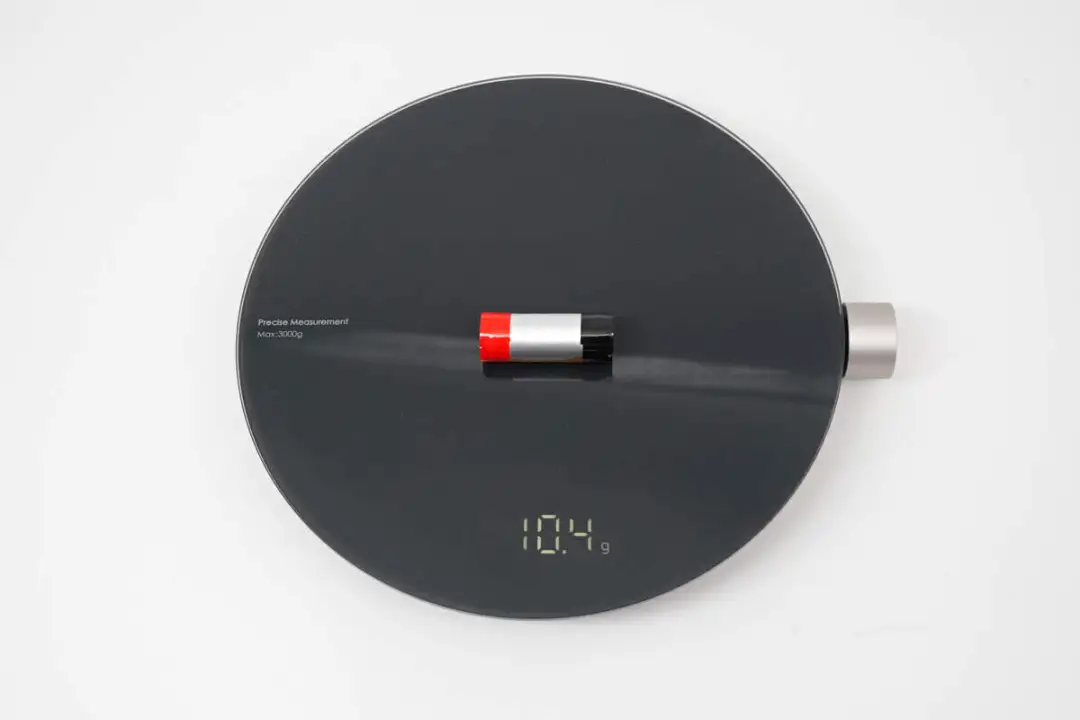
The Micro Power New Energy 13350-500mAh cell weighs about 10.4g.
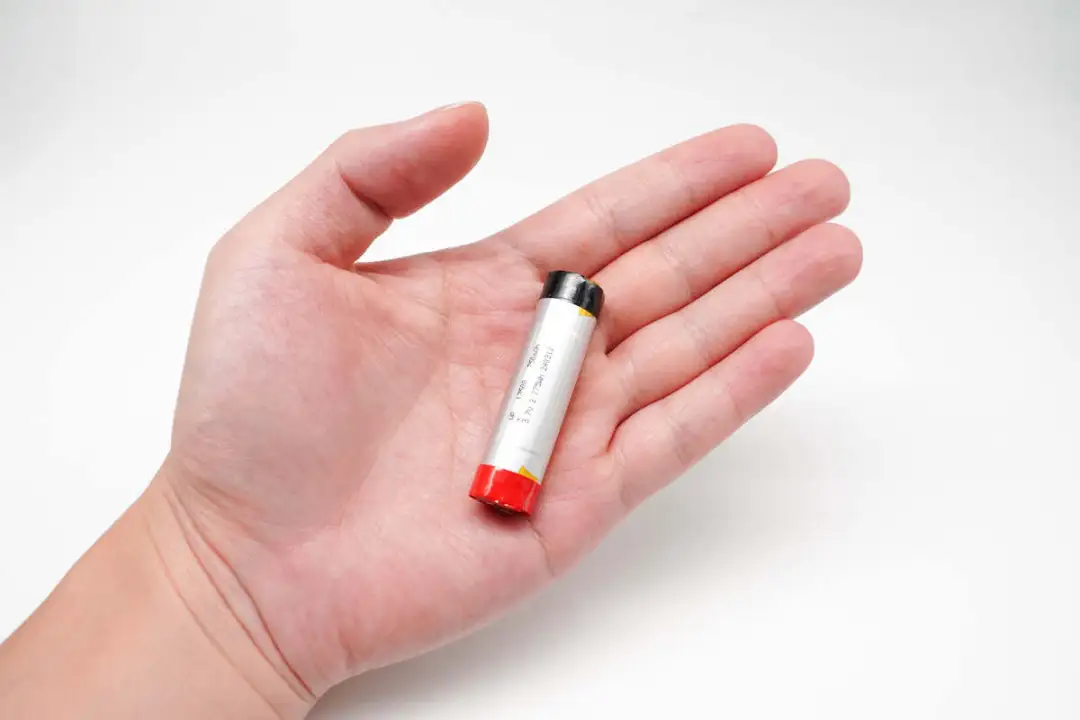
Comparison display of Micro Power New Energy 13350-500mAh batteries in the hands of an adult.
Charge and Discharge Test
After looking at the appearance, enter the main topic; the following will be 0.2C, 0.5C and 1C multiplier for charging and discharging test.
Charge Test
The charging test will perform constant current and constant voltage charging for 0.2C, 0.5C and 1C multiples and count their total elapsed time.
0.2C charging
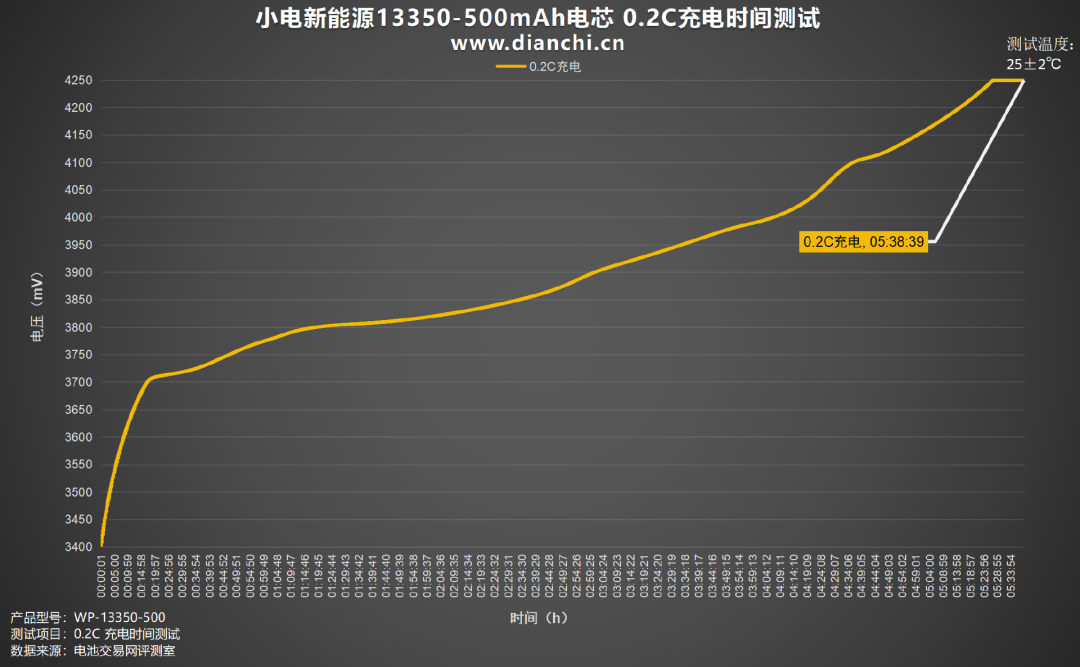
Plot a line graph, set the current to 100mA, 0.2C for Micro Power New Energy 13350-500mAh cell charging, charging cut-off voltage is 4.25V, time consumed 5 hours 38 minutes.
0.5C charging
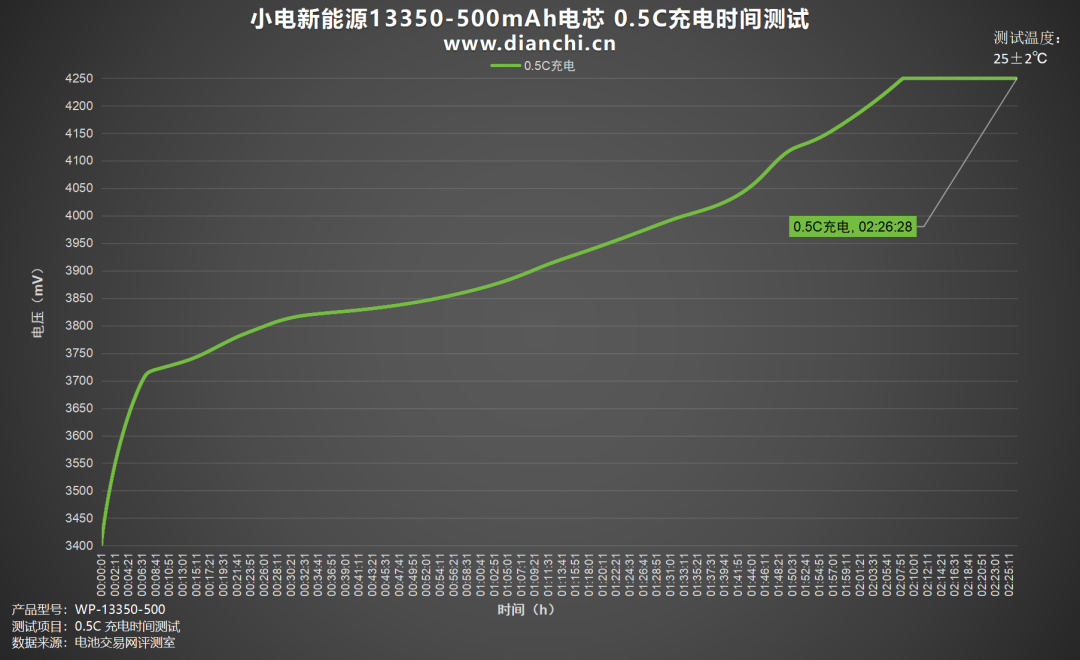
Plot a line graph, set the current to 250mA, 0.5C for Micro Power New Energy 13350-500mAh cell charging, the charging cut-off voltage is 4.25V, and the time consumed is 2 hours and 26 minutes.
1C charging
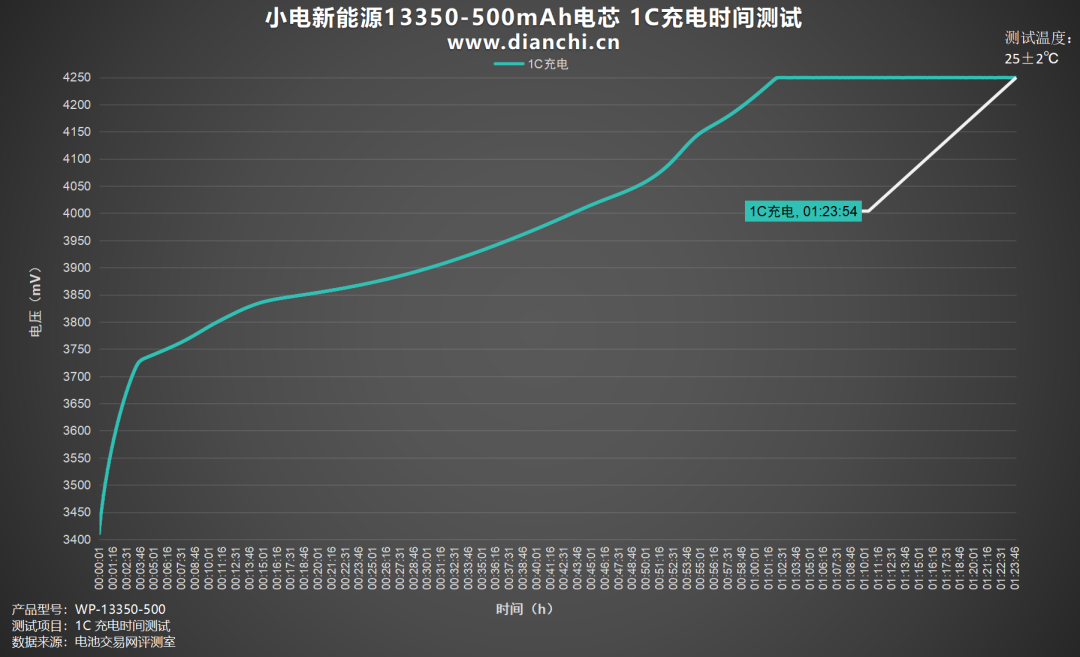
Plot a line graph, set the current to 500mA, 1C for Micro Power New Energy 13350-500mAh cell charging, charging cut-off voltage is 4.25V, time consumed 1 hour 23 minutes.
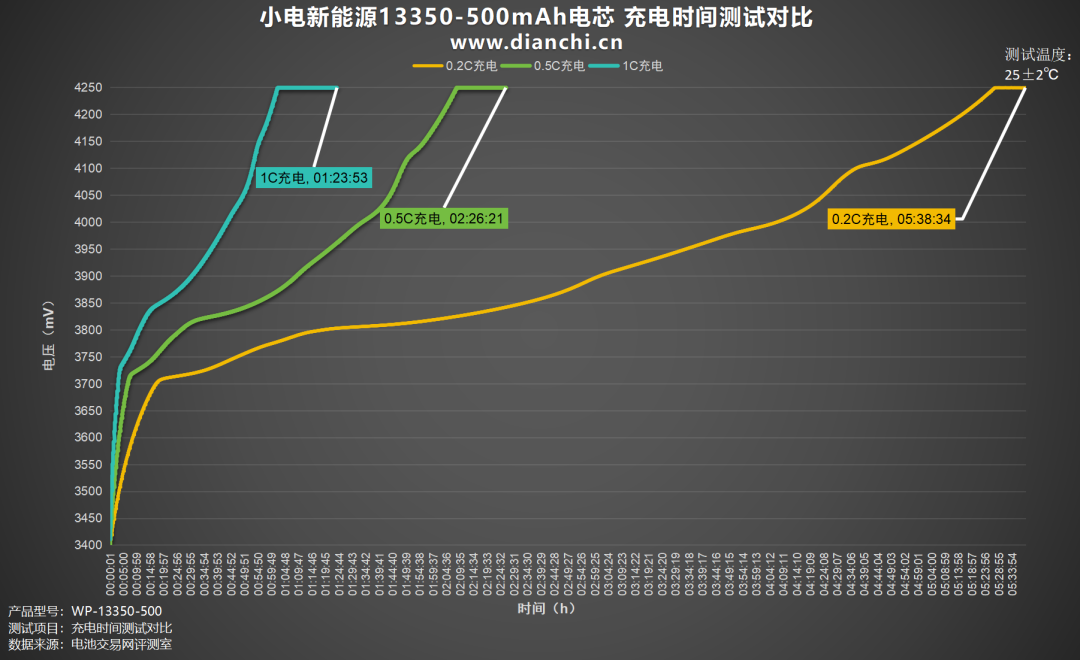
Plotting the test data as a line graph, the charging test took 5 hours and 38 minutes for a full 0.2C charge, 2 hours and 26 minutes for a full 0.5C charge, and 1 hour and 23 minutes for a full 1C charge.
Discharge testing
The discharge test phase will use constant current discharge, counting its total elapsed time and its discharged capacity and energy values.
0.2C discharge
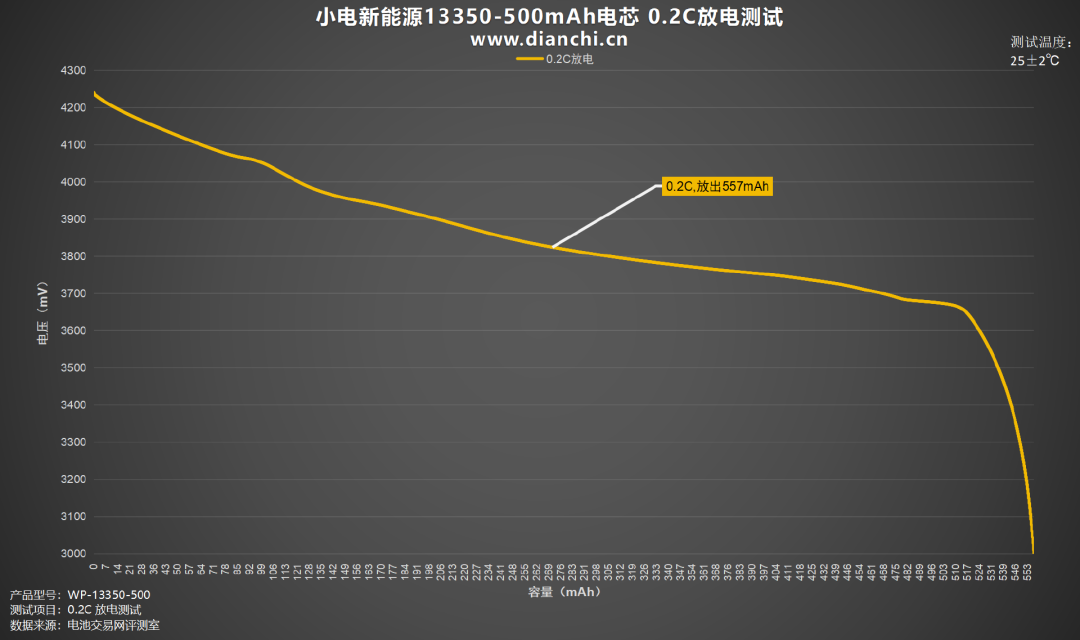
Draw a line graph, set the current to 100mA, 0.2C for the Micro Power New Energy 13350-500mAh core discharge, average voltage 3.84V, put to the cut-off voltage of 3V, time consumed is about 5 hours and 33 minutes, the discharge capacity of 557mAh, the discharge energy 2.14Wh.
0.5C discharge
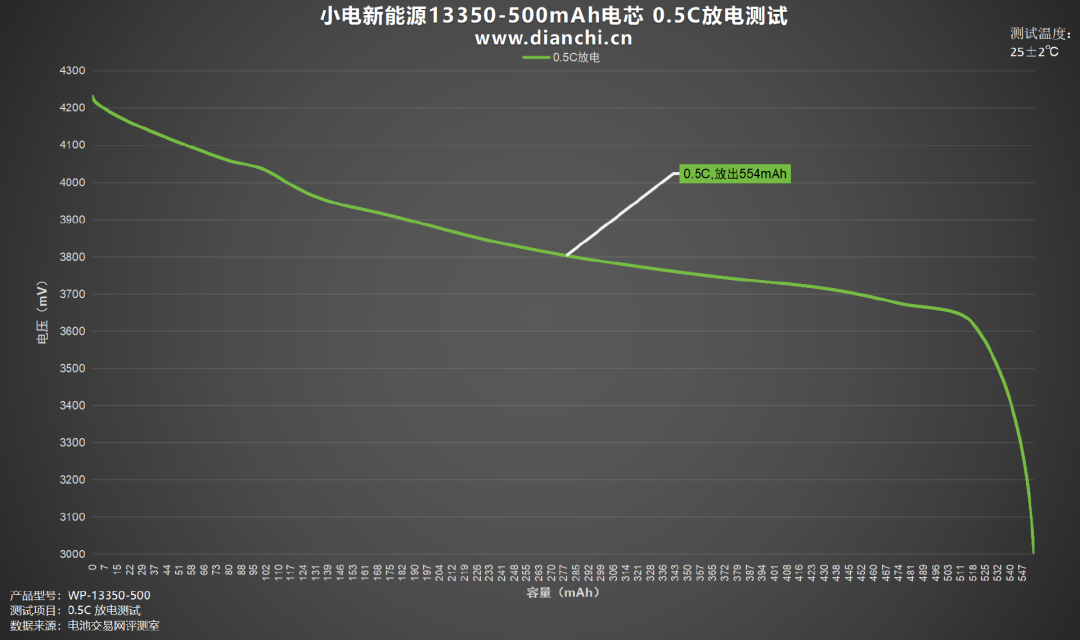
Draw a line graph, set the current to 250mA, 0.5C for Micro Power New Energy 13350-500mAh core discharge, average voltage 3.83V, put to the cut-off voltage of 3V, time consumed is about 2 hours and 12 minutes, discharged capacity 554mAh, discharged energy 2.12Wh.
1C discharge
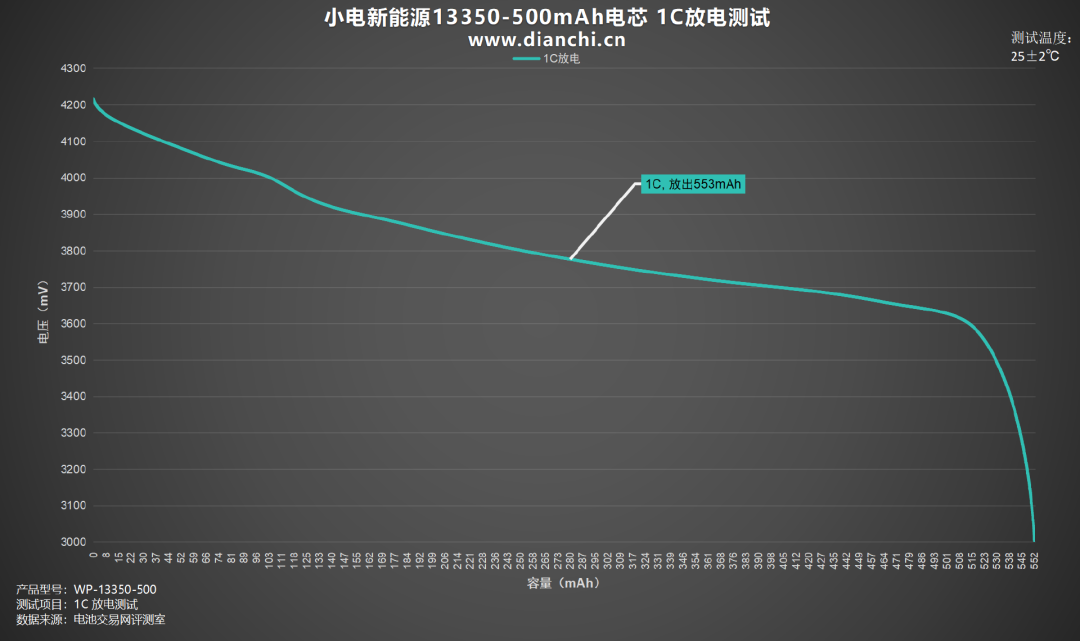
Draw a line graph, set the current to 500mA, 1C for Micro Power New Energy 13350-500mAh core discharge, average voltage 3.8V, put to the cut-off voltage of 3V, time consumed is about 1 hour and 6 minutes, discharged capacity 553mAh, discharged energy 2.1Wh.
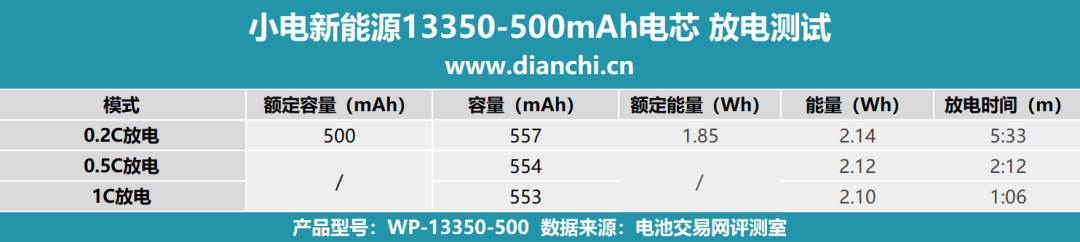
Summarising the test data into a table, it can be seen that the core is discharged at three multipliers to test the gap, with the shortest discharge time being 1C discharge, and the discharge time being about 1 hour and 6 minutes. The longest discharge time is 0.2C discharge, the discharge time is about 5 hours and 33 minutes.
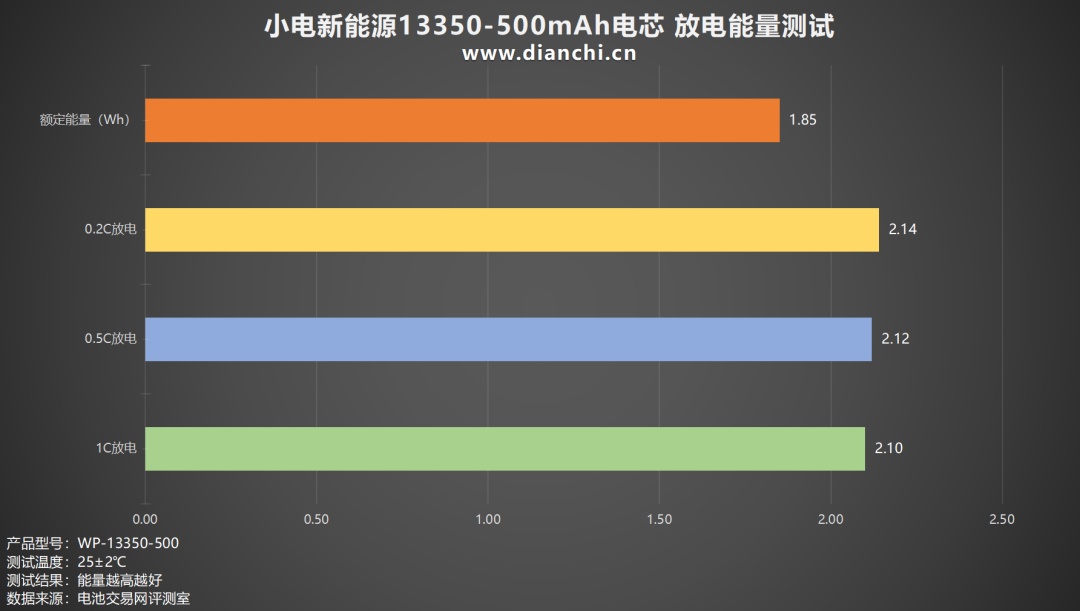
Summarising the test data into a bar chart, it can be seen that the highest discharged energy is 2.14Wh for a 0.2C discharge, and the lowest discharged energy is 2.1Wh for a 1C discharge, both exceeding the nominal energy and performing well.
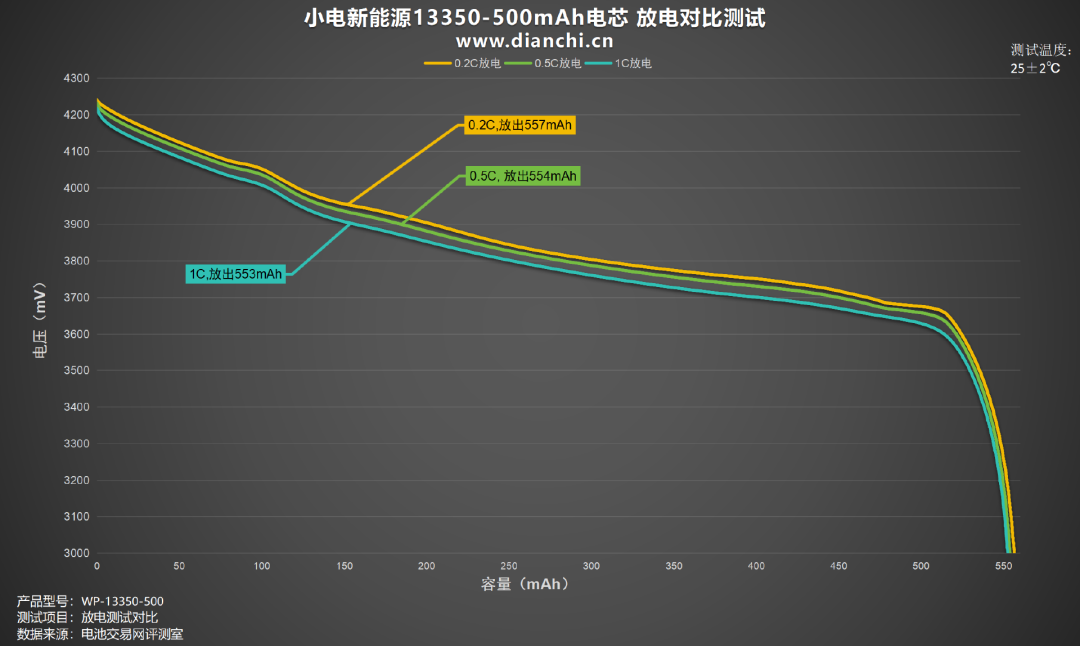
Let's take a look at the difference in capacity put out by each gear, plotting the data on a curve, we can see that the 0.2C magnification puts out a capacity of 557mAh, the 0.5C magnification puts out a capacity of 554mAh, and the 1C magnification puts out a capacity of 553mAh, and the three gears put out a capacity that exceeds the nominal capacity, which is an excellent performance.
Internal Resistance Test
In the internal resistance test section, BatteryTrader.com will use an internal resistance tester to test the full-charge internal resistance and empty-charge internal resistance respectively.
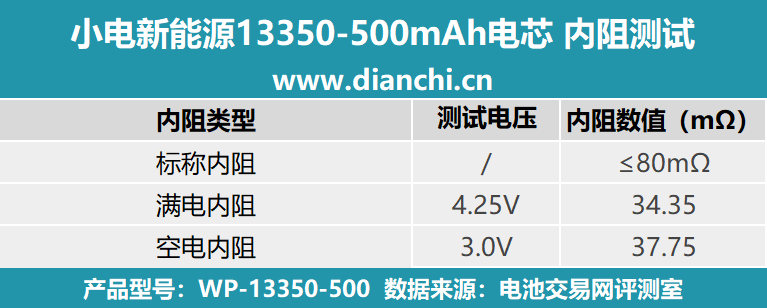
Summarising the test data into a table, we can see that the full internal resistance voltage is 4.25V, while the empty internal resistance voltage is 3.0V, and the nominal internal resistance of the new energy 13350-750mAh core is ≤80mΩ.
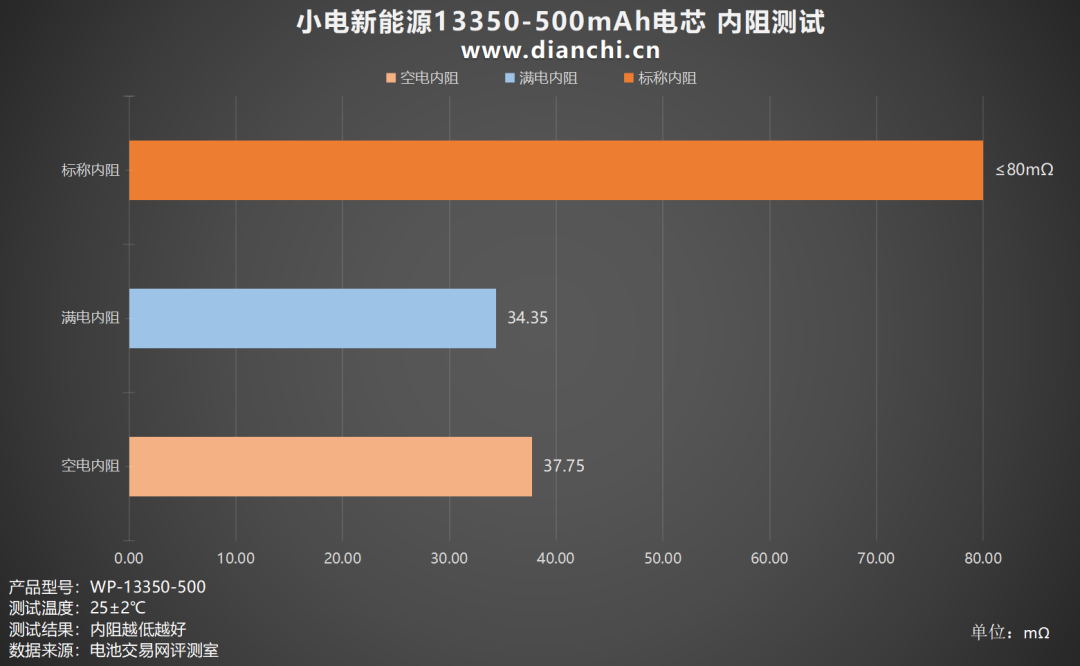
Plotting a bar graph, we can see that the internal resistance is 34.35mΩ at 4.25V fully charged and 37.75mΩ at 3.0V uncharged, neither of which exceeds the nominal internal resistance.
Temperature testing
For the temperature test portion, BatteryTrader.com will measure the temperature after 30 minutes of each charge/discharge multiplier.
Charging Temperature Test
0.2C charging
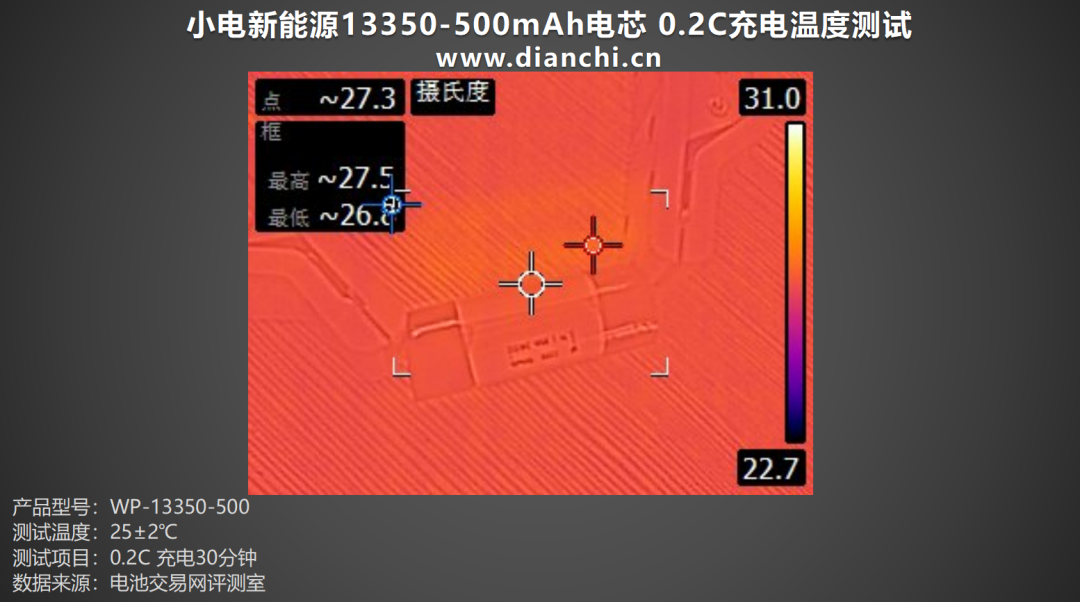
The Micro Power New Energy 13350-500mAh cell was charged for 30 minutes at a 0.2C multiplier, and the maximum surface temperature was about 27.5°C.
0.5C charging
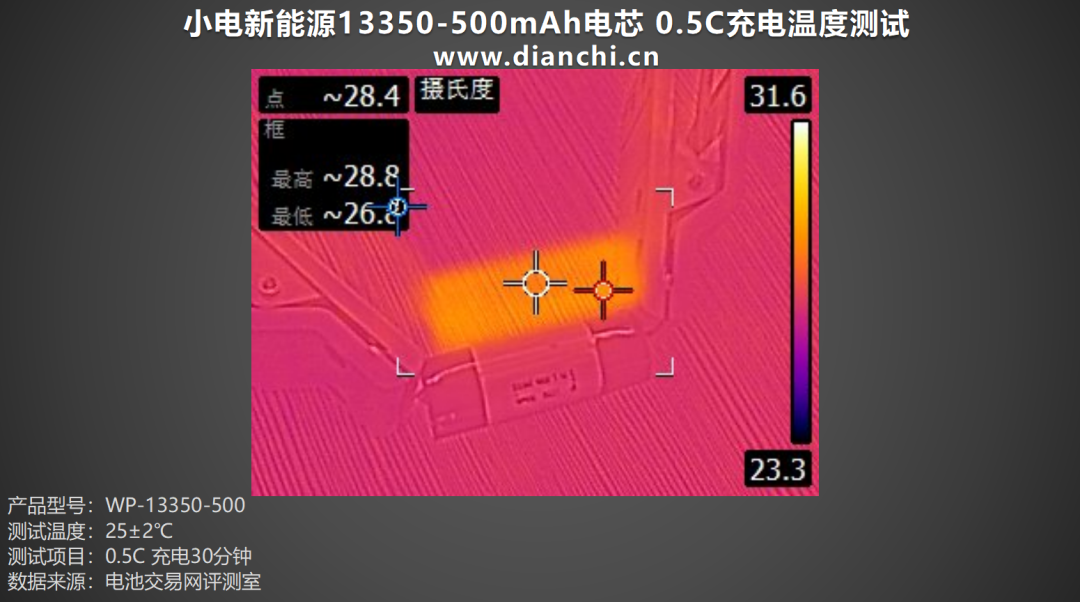
The Micro Power New Energy 13350-500mAh cell was charged for 30 minutes at a 0.5C multiplier, and the maximum surface temperature was about 28.8°C.
1C charging
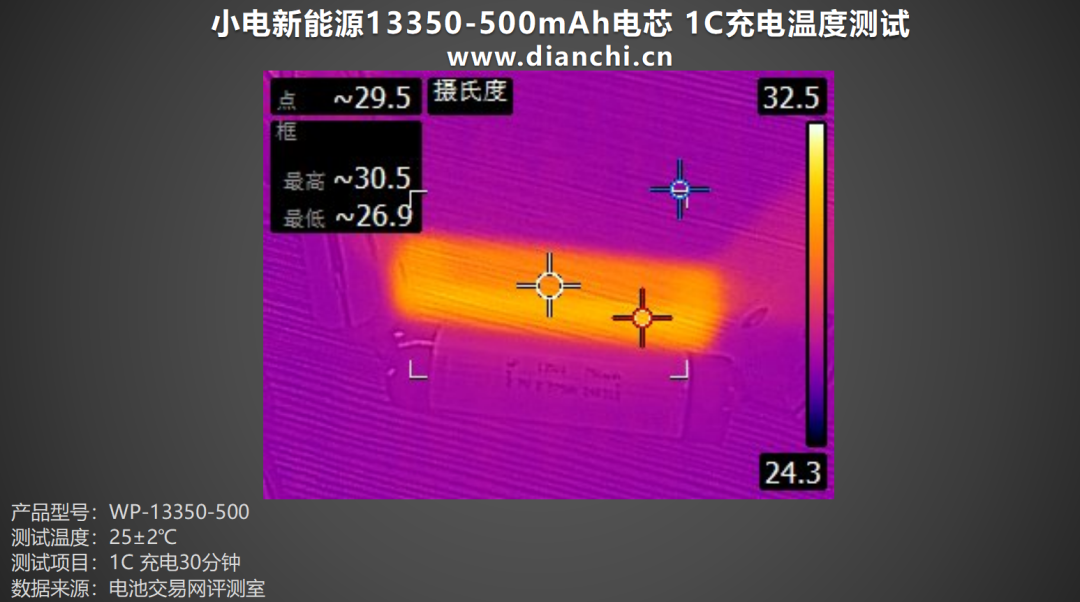
The Micro Power New Energy 13350-500mAh cell is charged at 1C times for 30 minutes, and the maximum surface temperature is about 30.5℃.
Discharge temperature test
0.2C discharge
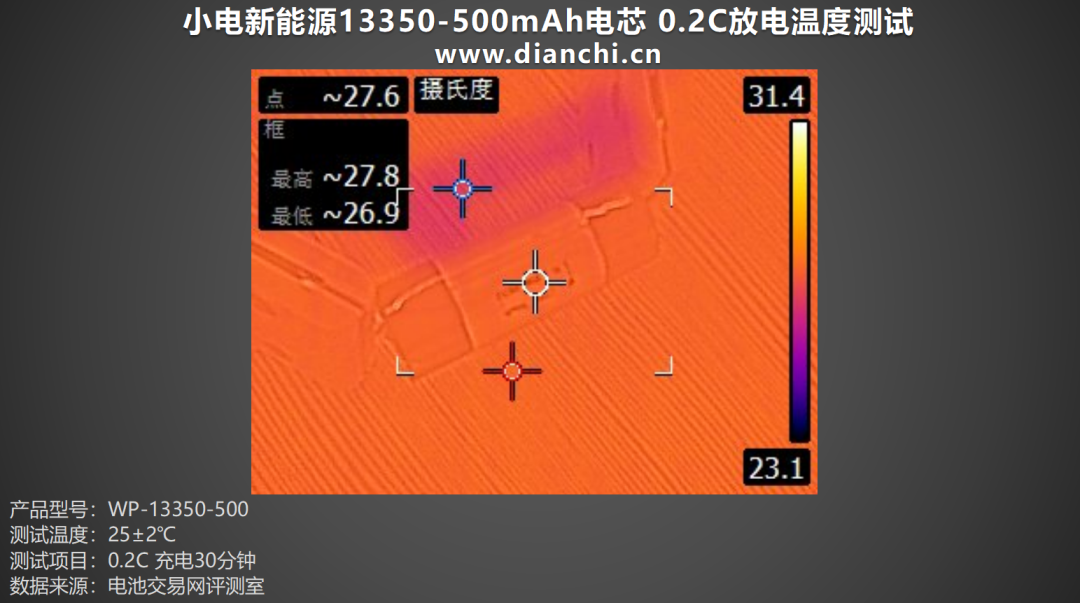
Micro Power New Energy 13350-500mAh cells were discharged at 0.2C multiplication rate for 30 minutes, and the maximum surface temperature was about 27.8℃.
0.5C discharge
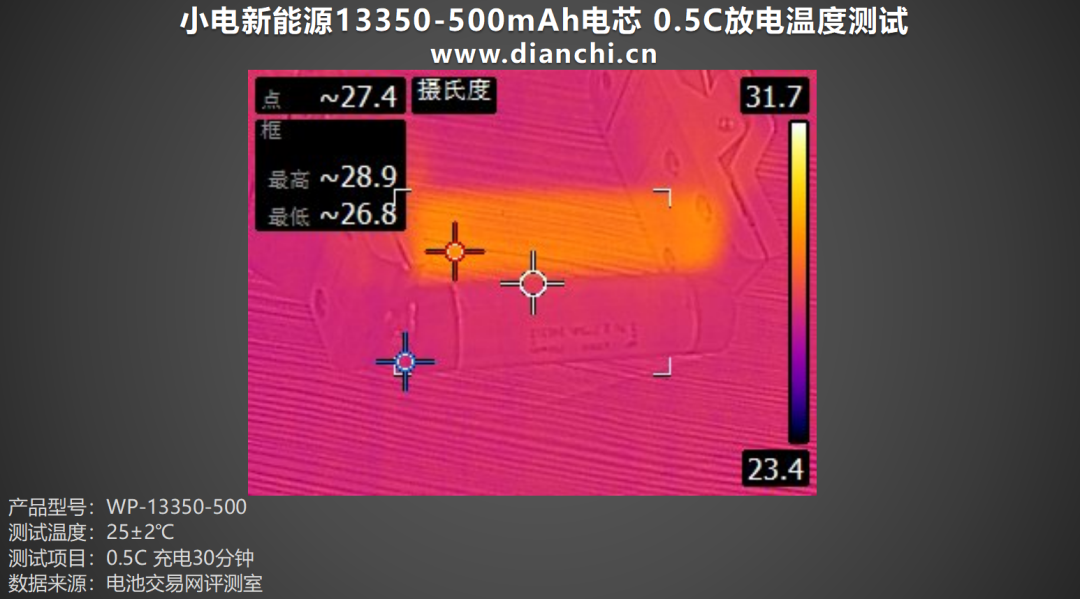
Micro Power New Energy 13350-500mAh cells were discharged at 0.5C multiplication rate for 30 minutes, and the maximum surface temperature was about 28.9°C.
1C discharge
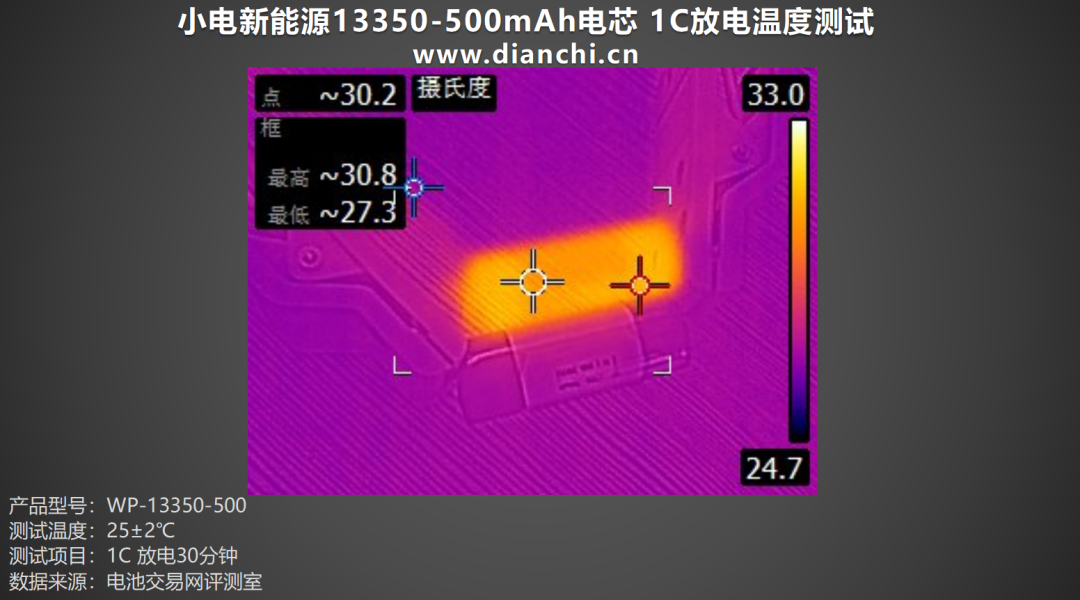
Micro Power New Energy 13350-500mAh cells were discharged at 1C multiplier for 30 minutes, and the maximum surface temperature was about 30.8℃.
Battery trading network summary
This Micro Power New Energy 13350-500mAh battery cell, battery trading network were in the 0.2C, 0.5C and 1C three times the rate of test, charging, 1C times the rate of charging can be 1 hour 23 minutes to complete the charging, the discharge part, you can see that the 0.2C times the rate of discharge capacity of 557mAh, the discharge energy reached 2.14Wh, excellent performance.
In terms of internal resistance and temperature, the Micro Power New Energy 13350-500mAh core also shows excellent performance. It can be seen that the internal resistance of 4.25V fully charged is 34.35mΩ, and the internal resistance of 3.0V uncharged is 37.75mΩ, neither of which exceeds the nominal internal resistance, and in the 30-minute test of charging and discharging with different multiplication rates, the charging and discharging temperatures are all in the range of 27-30℃ with good overall temperature control.
Overall, Micro Power New Energy 13350-500mAh battery is a stable performance, safe and reliable battery products, whether in daily use or in harsh working conditions, can meet the needs of users. For consumers and manufacturers pursuing high performance and high safety, this battery cell is undoubtedly an option worth considering.